

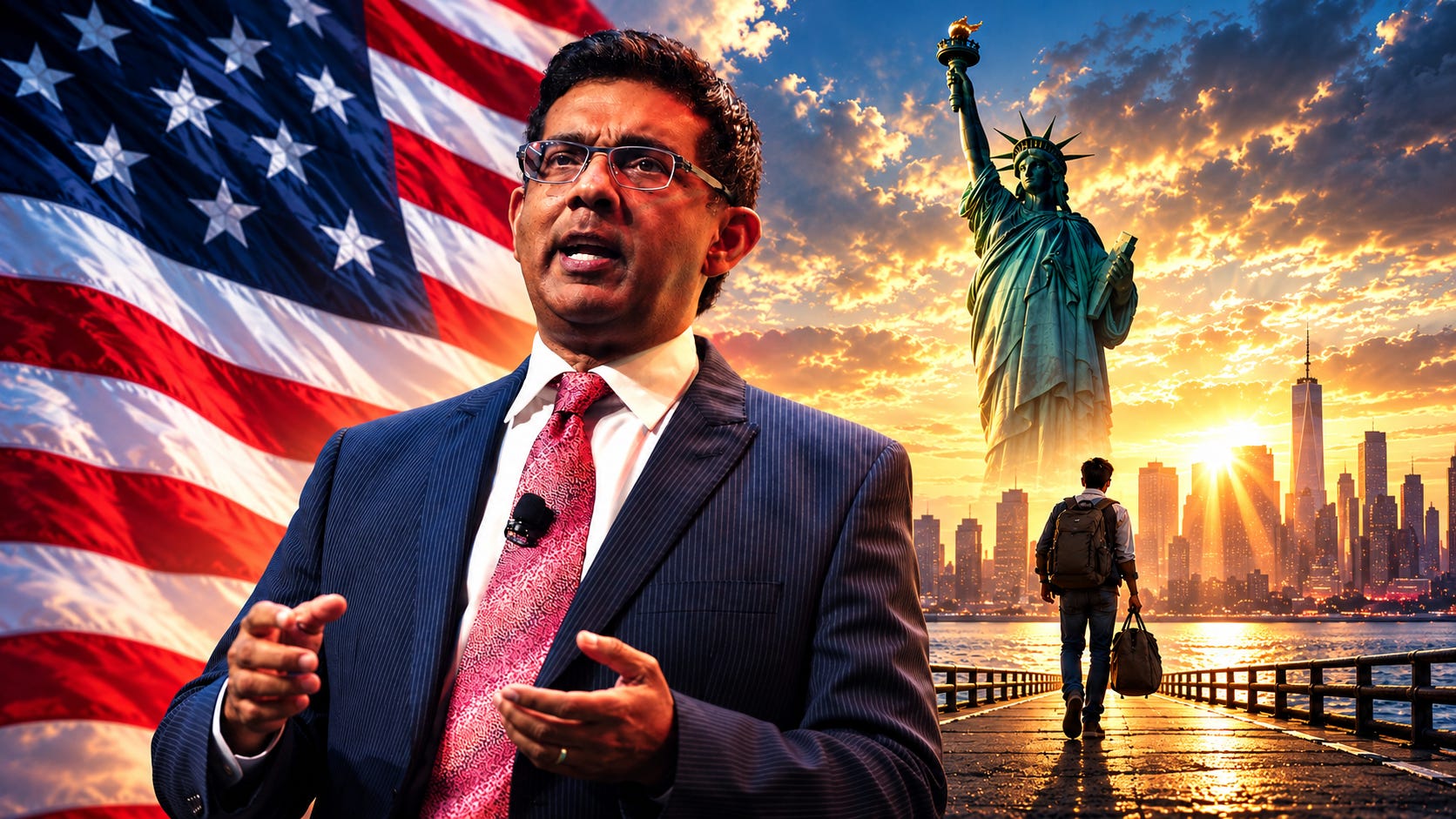
I thought a good topic for me to reflect on this evening is: What does it mean to be an American?
It’s an ever-relevant topic, although the trajectory of the debate around it varies from decade to decade. Rather than give you a theoretical analysis, I thought I would draw on some episodes from my own life to illuminate the ways America has changed—and how someone like me, born in a different country, can come to America and become American.
What does that involve?
I came to America as an exchange student at the age of 17. I lived with four families in Arizona and attended public school for the 12th grade.
Shortly after I arrived, my host parents said, “Dinesh, there’s a homecoming dance at your high school. You should really ask someone to go.”
I said, “I’ve only been in the country a few weeks. I don’t really know anyone. I think I’m going to have to give it a pass.”
They said, “No, it’s homecoming. It’s a big deal in America. You really need to do this.”
So I tentatively approached a young woman in my class—a blonde, as it turns out—and asked, “Would you like to go to the homecoming dance?”
She said, “Sure, but I have to ask my parents. I’ll tell you tomorrow.”
The next day, I went up to her and asked, “What did they say?”
She said, “Who?”
“Your parents.”
“About what?”
As I took in this rather awkward scenario, it suddenly hit me with an incredible shock of horror:
I had approached the wrong girl.
Reflecting on this later, I realized I was guilty of a very common Third World fallacy: all white women look alike.
Is Drinking Chocolate Every Day The Secret To Living To 100 Years Old?

My host parents had all kinds of plans for me. They were going to take me sightseeing—to Disneyland in California, the Grand Canyon, Tombstone, Arizona, the site of the gunfight at the O.K. Corral.
I thought that was amazing, but my idea of sightseeing was different.
I wanted to see the local supermarket.
I wanted to see 17 types of ice cream and 35 types of cheese.
The most striking initial impression America made on me was the abundance it provided to the ordinary person.
A rich person can live well almost anywhere in the world. What stunned me was what America provided not merely for the rich person, the smart person, or even the hardworking person. I’m talking about the mediocre guy—the guy who isn’t particularly hardworking and might even be kind of lazy.
That guy had a nice house. He had two cars in the driveway. In Arizona, he might even have a little pool in the backyard.
I thought: Wow.
A country can be judged by the kind of life it makes possible for the common man.
That was my first impression of America: how good the ordinary person had it.
I ended up staying. I went to Dartmouth on a scholarship, and later I began to understand that what is most important about America, at least from an immigrant’s point of view, is not simply the idea of an abundant life.
It is something more profound.
It is the ability to make a life in which you are the architect of your own destiny.
I realized there were things I could do with my life in America that would have been utterly unthinkable in India and unlikely in many other parts of the world, including Europe.
Your life could be a blank sheet of paper, and you were the artist.
You could be in the driver’s seat of your own life.
To me, that is the core meaning of the American Dream.
It’s interesting that there even is such a thing as an American Dream. Most countries don’t really have a dream.
When I think about India in the 1970s, weighed down by the Fabian socialism that Indian leaders had largely picked up in England, the Indian dream, as far as I could tell, was: How do we get out of India?
How do we escape?
And a whole generation did exactly that in one way or another.
As far as I know, there’s no Chinese Dream. There could be a French Dream, although I don’t think we want to know what it is.
But this American Dream is about being the master of your own fate.
This article is brought to you by Cacao Bliss from Earth Echo — a ceremonial-grade cacao drink with 7 superfoods that lower appetite, boost focus, and calm anxiety.
Frederick Douglass, the runaway slave, later gave lectures on what he called “The Self-Made Man.” Douglass understood that no one is entirely self-made, but nevertheless, he saw his own life as reflecting an America in which you not only walk the path—you make the path you walk on.
That gets to something America has elevated from the beginning: the innovator, the builder, the person who creates something new—something new of America, something new of the world, and something new of themselves.
In my younger days, I was very much a product of the Reagan Revolution. To me, Reagan represented a kind of big-sky conservatism, an optimism about America.
I had the privilege of working in the Reagan White House. I didn’t interact with Reagan, but I got to stand in the back of the room and watch Reagan do his thing.
The great issue of the 20th century was collectivism: Soviet expansion abroad, but also the rise of the welfare state at home, beginning with FDR and continuing through Lyndon Johnson and the so-called Great Society. Politically, this is what we were against.
But there is something else about the Reagan years worth highlighting because it is largely gone now.
In Reagan’s America, there was a general sense that American politics was a debate among friends.
The left and right disagreed about means, but broadly agreed about ends.
If you walked around America in the 1980s and asked people: Should America be strong? Should America be prosperous? Should America be an example to the world? Does America have something to teach the world? Should we have an abundant, lawful society? Should young people be raised with knowledge and civic virtue?
You would have gotten essentially a uniform “yes” across the board.
The debate was over how to achieve those things.
If we create prosperity and have a large pepperoni pizza, how do we carve it up? Who gets what? How do we distribute that abundance?
But somewhere between Reagan and Obama, that America disappeared.
We moved into a different kind of America, and my own view of America and American politics underwent a dramatic revision.
If I had given this speech around the year 2000, I probably would have continued in the optimistic vein I’ve been describing.
But then came a sharp turn in my own life.
After the 2012 election, I found myself standing in a courtroom and heard the bailiff say:
“United States of America versus Dinesh D’Souza.”
That is not a phrase any immigrant wants to hear.
I had exceeded campaign-finance limits by contributing $20,000 of my own money to a college friend who was running for office. It was a quixotic campaign, and she lost badly, as was obvious from the beginning. It was a first-time offense, and there was no quid pro quo.
A few weeks earlier, however, I had made a film about Obama that was playing in theaters.
Over the years, when I’ve spoken on campuses, people have asked me, “What makes you think you were politically targeted? How do you know Obama even saw your movie?”
My response is that I was being attacked every day on a website called BarackObama.com. That gave me the idea that perhaps he didn’t like the film.
But this was immigrant naivety on my part.
If you anger the most powerful man in the world, the empire can strike back.
I ended up spending eight months in an overnight confinement center. I wasn’t incarcerated during the day, but every night I had to check in at 7 p.m., sleep on bunk beds alongside criminals, and check out again in the morning.
Before I went in, I called a friend and said, “I really don’t know what to expect. This is completely new to me.”
He said, “Dinesh, come on. You’re from India. You’re going to be fine.”
And believe it or not, I was.
Part of the reason was that I performed a certain mental operation. I told myself I was an anthropologist who had been parachuted into Papua New Guinea. I was going to be among the natives, and I needed to take an anthropological approach.
What I really asked myself was: What is the goal of the people who put me here?
Was their ultimate goal simply to lock me up?
I decided it wasn’t.
The goal was to destroy my career.
I look at what happened to Trump in a similar way. If Trump had said, “I’m going to retreat to Mar-a-Lago and never run again,” I believe much of what followed would have disappeared. The objective was political: take the guy out.
So I told myself that if I came out of this ruined—unable to write a book, unable to get a publisher, unable to make a film, unable to get a meeting—then they won.
But if my career was even bigger at the end of it, then I won.
Little did I know that my case would be a forerunner of what would later happen to Carter Page, George Papadopoulos, Michael Flynn, and Trump himself.
I thought my experience was a one-off. I thought I had angered a vindictive president and he was coming after me. Instead, I came to see it as the beginning of what we now call lawfare.
I became an early student of what I would call the gangsterization of American politics.
And it was a shock.
It is also difficult to convey that shock to other people because they are naturally incredulous, just as I would have been had someone told me these things before I experienced them myself.
I think people became more skeptical after COVID because institutions that many Americans trusted began to lose that trust.
As a conservative, I already distrusted much of the media, universities, and Hollywood. But I trusted the FBI. I trusted the health authorities.
Why would they be lying?
After COVID, many people began asking harder questions about institutions they had previously assumed were acting in good faith.
There is also a softer version of this transformation.
Is Drinking Chocolate Every Day The Secret To Living To 100 Years Old?
Today, I don’t think we can say that Americans merely agree on goals and disagree about means.
Increasingly, we disagree about the goals themselves.
That is the essence of our polarization.
The old advice was: Why don’t you two sides sit down, work it out, and find some middle ground?
That works if we’re both trying to travel from Florida to Maine and merely arguing about whether we should drive or take the train.
But if one side wants to go to Maine and the other wants to go to Chicago, you have a completely different problem.
This is another side of America that I came to recognize later in life.
And it extends beyond politics.
A lot of young people today are lost about how to get ahead economically. They can’t afford a house. Everything seems expensive.
“Mom and Dad, you bought a house for $300,000 in the 1990s. That same house is now $940,000. How much would I have to earn just to make the down payment?”
When I came to America in 1978, I had $500 in my pocket.
I thought recently about what would have happened if I had been unbelievably frugal and never spent a penny of it. What would that same $500 buy today?
Its purchasing power would be dramatically lower.
We say everything has become more expensive, but another way of looking at it is that our money buys less.
When the word “inflation” was originally used in monetary economics, it referred to an expansion of the money supply. Inflate a balloon and you blow it up. Inflate the money supply and, all else equal, you put upward pressure on prices.
But today, when prices rise, people simply say, “That’s inflation.”
Then they turn to the government and ask it to solve the problem.
My point is that I came to America wide-eyed. It took me a long time to start looking at what happens behind closed doors and out of sight—things that can have powerful consequences for ordinary people.
This is why, in the Trump era, the phrase “Make America Great Again” resonated with many people.
It invokes the idea that there is a spirit that built America: innovation, imagination, creativity, fair play, a level playing field, and straightforward rules.
I’m talking about principles.
I’m not saying there was some perfect moment in American history when none of those principles were ever violated. There wasn’t.
But the principles were there, almost like our own Ten Commandments.
What has changed is that many of those principles have become diluted, abused, or attacked.
I was tempted to open—and perhaps I should close—with something appropriate to a university environment: a land acknowledgment.
Land acknowledgments are now everywhere. My wife and I went to Sydney, Australia, and even as you’re landing, they acknowledge the original inhabitants of the lands you are passing over.
But as an immigrant, my land acknowledgment is a little different.
I’d like to acknowledge Christopher Columbus. If he hadn’t come to America, I wouldn’t be here.
I like the American Indians. I’m not opposed to turquoise jewelry. But I don’t think I would have come to America for that reason.
I even like the Spanish conquistadors. Yes, they were greedy, murderous swordsmen, but they also brought Western civilization to a continent that did not have it.
I like the Pilgrims who landed at Plymouth Rock.
I like the people in covered wagons who went west.
I like the cowboys who built out Texas and fought the Mexicans.
Now, much of this is unspeakable in many university environments.
When I’ve spoken on campuses in the past, I’ve sometimes kept one eye on the exit because there are moments when you need to get out the door quickly.
Many years ago at Stanford, I had the opportunity to debate Reverend Jesse Jackson.
The subject was whether America is a racist society.
Jackson is a formidable debater. He has a distinctive rhetorical style, and I remember watching him and realizing something.
He and I are roughly the same color. We both have children, and their experiences of America are probably not radically different.
So why did he and I see America so differently?
It occurred to me that perhaps we were measuring America by two completely different standards.
An immigrant, having been raised in another society, almost inherently uses the comparative method.
America has racism?
Compared to what?
What is it like in the Congo? What is it like in Sri Lanka? What is it like in Russia?
Jackson, I realized, was using a different standard. His approach was more utopian: America was being measured against its own ideals, or against some ideal standard of what society ought to be.
If America fell short, that failure became the focus.
It gave me an insight: sometimes we weren’t directly debating the same question at all. We were applying completely different calculations to how we assessed America in the first place.
Let me close by saying that, to me, an American is not simply somebody who comes here.
Becoming American requires a journey.
Imagine two tall buildings. One is India. The other is America. There is a tightrope connecting them, and your job is to walk across it.
Once you get far enough out, you experience a kind of vertigo—not simply because you might fall, but because you realize you’ve traveled far away from the old building without yet reaching the new one.
You enter a no-man’s-land in which you belong completely to neither society.
That produces a fear that makes you want to turn around and rush back to the place you came from.
The project of assimilation requires resisting that impulse and continuing across.
That isn’t easy.
It was made easier for me because when I lived in Arizona, I honestly never met another Asian Indian. When I went to Dartmouth in the early 1980s, there were perhaps four or five Indians on the entire campus.
I rarely saw them.
One of them, somewhat irritatingly, insisted on speaking Hindustani to me every time she saw me. I would try to avoid her because I found it embarrassing when we were standing in a group and someone suddenly reverted to the old-country language.
My attitude was: We’re adults. We don’t have to do this. You speak English.
That is part of the push and pull of assimilation.
It isn’t simply a matter of coming to America for opportunity.
It isn’t simply coming for a better life.
It isn’t even simply coming to America and embracing the Constitution.
Because the Constitution, believe it or not, is not by itself the guarantor of our liberties.
Consider COVID.
As I see it, during COVID many rights protected by the Bill of Rights—from free speech to religious freedom to freedom of assembly—were violated or sharply restricted.
Where was the Constitution?
A document cannot jump off the page and come to your rescue.
The Constitution is essential, but there must also be a mindset that wants to implement it. There must be people who have an appropriate reverence for it.
So America, to me, ultimately means assimilating into the principles, ideas, way of life, and practices that built this country.
But there is another kind of assimilation.
Recently, a photo circulated on X showing roughly 100 wildly enthusiastic Asian Indians cheering at a University of Texas football game.
Some people on the right circulated the photo as evidence that Texas was becoming overrun with Indians.
But it was an odd image to use for that argument.
These weren’t newly arrived immigrants. Many were Indians born in America. They were at UT. They were at a football game. They were wearing orange. They were cheering for their team.
You might think: Isn’t this assimilation?
Yet some people on the right respond that these young people come to America, benefit from America, and then vote in ways that undermine both the country and the conservative values with which their parents raised them.
That leads to my final point.
Their problem is not necessarily that they aren’t assimilating.
They may be assimilating into a different America.
Young, smart Asian Americans arrive at places like Columbia, Berkeley, or Duke wanting to understand what it means to be American. They quickly learn what the dominant culture around them expects them to believe, what causes they are expected to champion, and what attitudes will make them accepted by their peers.
They want to be part of the action. They want to fit in. They don’t want to be uncool.
So they assimilate.
That, too, is assimilation.
The issue is more complex than simply asking whether immigrants assimilate.
The real question is: What are they assimilating into?
I have tried to assimilate into what I believe is the America that made America—the principles of innovation, freedom, opportunity, self-government, individual responsibility, fair play, and the ability to become the architect of your own destiny.
But there is also, in my view, an effort to undo that America.
And there is an assimilation into that vision as well.
That is the assimilation I believe should be resisted, because it would produce an America that, if our founders were here to see it, I think would horrify them.
This article is brought to you by Cacao Bliss from Earth Echo — a ceremonial-grade cacao drink with 7 superfoods that lower appetite, boost focus, and calm anxiety.
Thanks, Dinesh. Spot on. I bought the movie you referenced. Totally agree with your theory of different kinds of assimilation
Our education system is chipping away at not liking America little by little.