

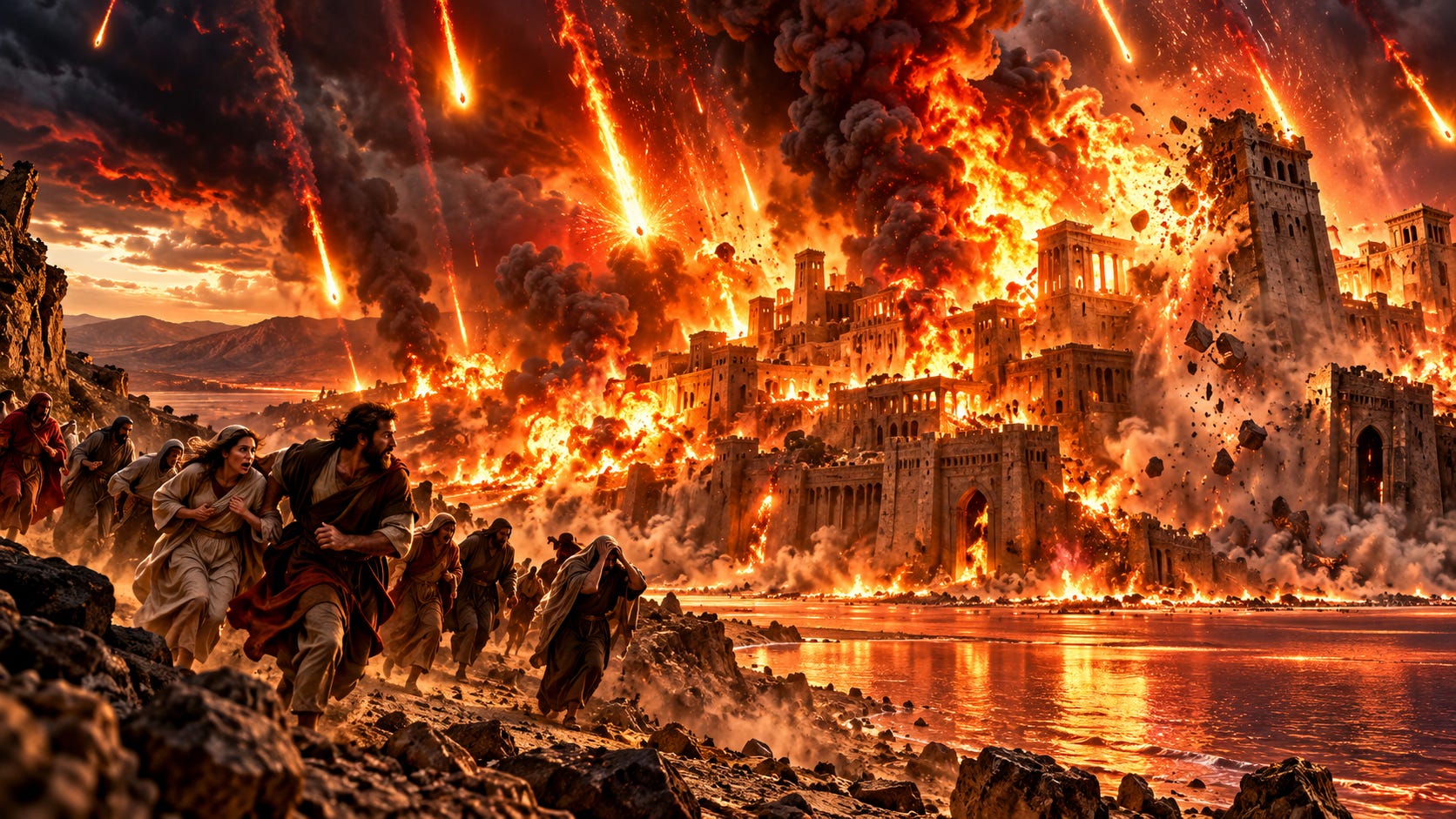
In the latter days of Abraham's life, according to the Bible, fire and brimstone rained down on the cities of Sodom and Gomorrah, destroying them completely. From a vantage point in Hebron, a long distance away, Abraham saw the smoke rising from the conflagration.
The destruction of Sodom and Gomorrah in Genesis 19 is one of the most memorable accounts in the Bible, representing divine wrath and punishment for persistent human sin and wickedness. Thus, Sodom and Gomorrah are sometimes called the sin cities of the Bible.
While skeptics over at least a couple of centuries have insisted that Sodom and Gomorrah are legendary, and that the Bible is merely giving us a morality tale, the Scriptures portray the destruction of the two cities as a historical rather than an allegorical event. But if Sodom and Gomorrah were incinerated in a fiery conflagration nearly 4,000 years ago, the evidence of that destruction might give biblical archaeologists the opportunity to locate those two ancient cities.
So, where are they?

From various biblical references, it's quite clear that Sodom and Gomorrah are somewhere near the Dead Sea. Since the 1920s, the traditional view of biblical archaeologists is that the two cities were quite likely located near the southeastern coast of the Dead Sea. In subsequent decades, archaeologists excavated two promising sites in the region: Bab edh-Dhra, which they identified with Sodom, and Numeira, which they identified with Gomorrah. Notice that Numeira even sounds somewhat like Gomorrah, and this is significant, because many ancient cities changed their names over the centuries, but in a manner that preserved the echoes of their original names.
We recognize the names Sodom and Gomorrah instantly, but the Bible actually speaks of five cities of the plain. The other three are Admah, Zeboiim, and Zoar. Four of the five were, according to the Bible, wiped out. Zoar was spared. In fact, Abraham's nephew Lot, who lived in Sodom, survived by fleeing to Zoar, where he and his family lived in a nearby cave in the mountains.
One of the great treasures of biblical archaeology is called the Madaba Map. It is a mosaic map that was found on the floor of a church in Madaba, Jordan. It has a detailed depiction of Israel, then called Palestine, its Roman name, in the 6th century AD. The Madaba Map, which has enabled archaeologists to find many ancient locations subsequently lost to history, appears to place Zoar on the southeast shore of the Dead Sea, in the vicinity of Bab edh-Dhra and Numeira.
Both Bab edh-Dhra and Numeira were destroyed by fire. Archaeologists have found charcoal, broken and fallen bricks, and large areas of ash at Bab edh-Dhra. The fire seems to have incinerated and collapsed the city walls. Stones and boulders from walled structures were scattered along the slopes of Bab edh-Dhra. Numeira was also burned. Archaeologists found evidence of earthquakes that might have produced the fires or occurred in conjunction with the fires. Eventually, both sites were permanently abandoned.
So far, the evidence seems compelling, but the problems are with the dates of these events. Radiocarbon dating puts the destruction of Bab edh-Dhra and Numeira centuries earlier than Abraham's time. Some results even say that Bab edh-Dhra and Numeira were not destroyed at the same time, which would pose a serious problem if we are trying to corroborate the biblical account. The Bible is emphatic that these sin cities were destroyed simultaneously.
Archaeologist Steven Collins has caused quite a stir in the scholarly community by advancing a rival location for biblical Sodom. He places Sodom at the northeastern end of the Dead Sea. In a way, his thesis is not original. Many biblical scholars through the centuries thought Sodom must be roughly where Collins said it was. But their views were entirely based on the biblical account. They lacked any archaeological support. That's where Collins came in.

Now, Collins was initially convinced that Sodom was Bab edh-Dhra and Gomorrah was Numeira. But he also recognized the problem with those identifications. So, in a classic illustration of how biblical archaeology works, he went back to the biblical text. There he found a problem even more serious than any radiocarbon dating mismatch. He found a mismatch between the two locations and the text itself.
The Bible says in Genesis 13:8–12 that when friction developed between Abraham and his nephew Lot, on account of their large herds grazing the same lands in the region of Bethel and Ai, Abraham proposed that he and Lot take their herds different ways. Lot, we read, "saw that the whole plain of the Jordan toward Zoar was well watered, like the garden of the Lord," and so he went east in that direction, "as far as Sodom."
Collins realized that from Abraham and Lot's vantage point, the only visible plain was at the northern end of the Dead Sea. That is the plain that is fertile; it was well watered then, as it is today. And if Lot went east in that direction, it must mean that Sodom was located at the northeastern end of the sea, not the southeastern coast, as the traditional view held.
Collins excavated at a site called Tall el-Hammam, where he believes he has found biblical Sodom. At Tall el-Hammam, Collins found thick layers of destruction, with collapsed walls, burned debris, even skeletal remains, all inside a three-foot-thick layer of ash. Quite clearly, this ancient city was thoroughly incinerated, and other adjacent cities around it have a similar archaeological profile, showing that they too endured a similar fate.
Soon, however, Collins and his team encountered a serious problem. They found pottery in the ruins that was covered, or glazed, with a greenish, glass-like surface. Collins was dismayed. As a pottery expert, he knew right away that glazing techniques did not exist in 2000 BC, and that glazed pottery largely begins with the Islamic period, which is around the 7th century AD. Collins considered that perhaps his thesis had been refuted.
Just to be sure, Collins sent pottery fragments, or shards, to be tested at the U.S. Geological Survey lab in New Mexico. He was astounded to hear from the geochemists there that what they were testing was not glazed pottery at all. Rather, it was a substance called trinitite.
Trinitite is not the name for a glaze applied to pottery. Rather, it is the name for the pottery itself when it is subjected to extreme heat, the type of heat that occurs in a meteoric or nuclear explosion. Scientists in New Mexico first encountered trinitite in the aftermath of the nuclear tests in the desert in the 1940s. Robert Oppenheimer, director of the Los Alamos lab, gave the first nuclear test the code name Trinity, and the heat from that blast was so intense that it melted the sand, turning it into green glass: trinitite.

Collins now realized that what happened over Tall el-Hammam was a meteor or asteroid explosion. The explosion was not the result of impact with the Earth, but had occurred in the sky, within the Earth's atmosphere, generating heat that is estimated to be the equivalent of a thousand Hiroshima bombs. That is what wiped out a thriving city. That is what created the trinitite. Notice how closely this scenario matches the biblical account of fire and brimstone raining on Sodom and Gomorrah.
I would like to leave it there, but as with so many persuasive theories, there is a hitch. Once again, it has to do with the date. Radiocarbon testing by Collins and others dates the destruction of this ancient city and its surroundings to 1750 to 1650 BC. This is obviously a mismatch if Abraham lived in 2000 BC.
But hey, do we know for sure that Abraham lived in 2000 BC? Actually, we do not. Biblical chronologies are open to dispute, even among scholars who completely accept the reliability of the Bible. Collins thinks that maybe Abraham and the patriarchs lived later than previously thought, but he acknowledges the mismatch of dates between the destruction debris at Tall el-Hammam and the generally accepted dates for the biblical destruction of Sodom and Gomorrah.
What we learn from this dispute over alternative locations for Sodom and Gomorrah is that biblical archaeology is not always an exact science. Facts are objective; interpretations less so. Sometimes things can be known tentatively, not definitively. Science, as we know it, gives us probability rather than certainty. There are good scholars on both sides of the Sodom and Gomorrah debate. I expect that at some point in the future we'll have further evidence that will settle the issue. Biblical Sodom and Gomorrah are still somewhat elusive, but I believe the time is not too distant in which they will come fully into view.

Fascinating about trinite glass formation—
I always hold onto the Biblical accounts regardless of the attempts to explain causation. If our Creator could create the world, the Sun, the planets and all that is in them including us and our brains, surely His ways are beyond our comprehension.
Sodom and Gomorrah was destroyed by God through fire because man wanted to have sex with Angels. God couldn't find 10 righteous people.